
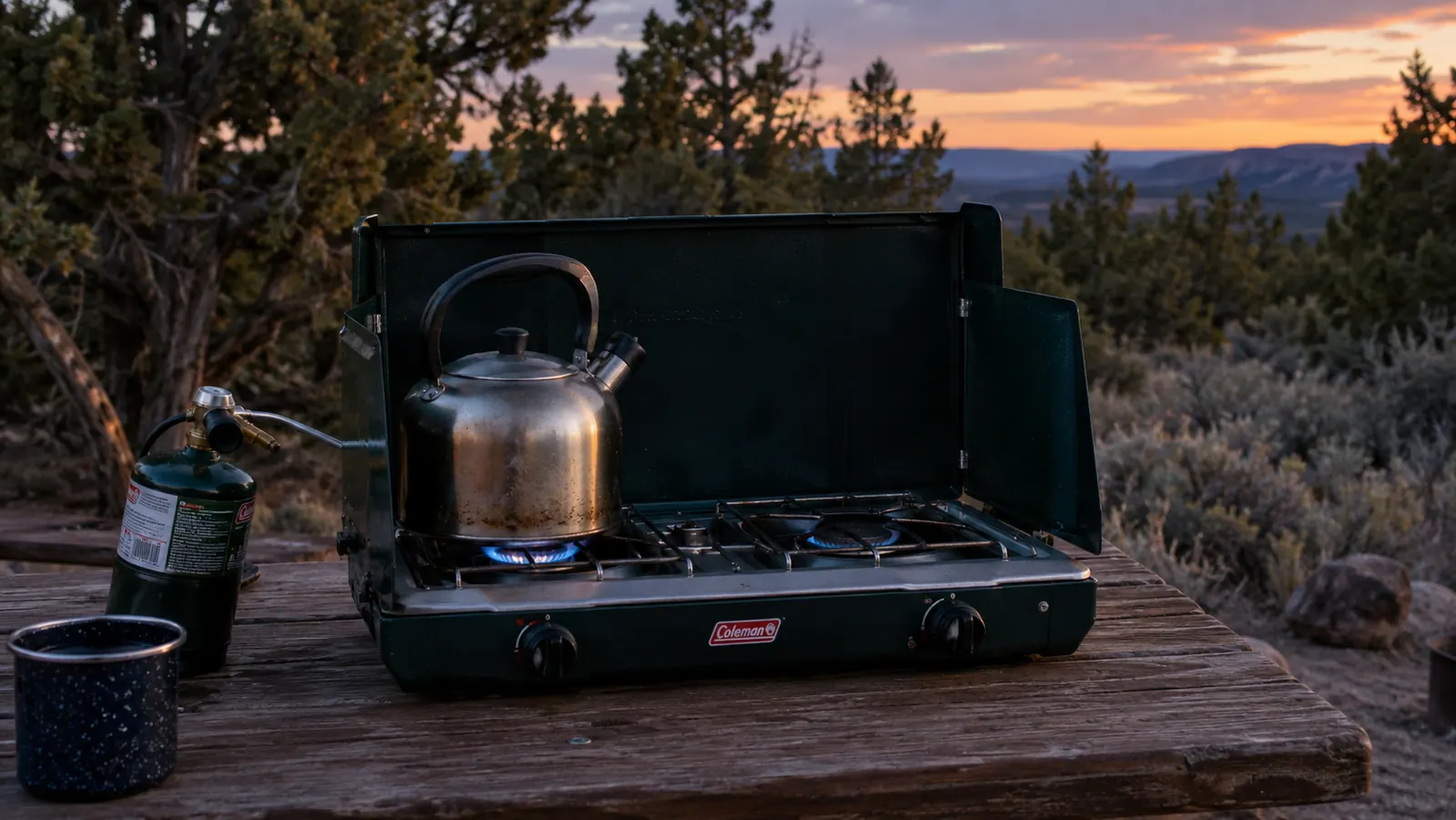
The wind came up around nine that night, the way it does in the high desert east of the Cascades. We were camped at about 6,800 feet, north of Smith Rock, and the gusts were swinging between fifteen and twenty-five miles an hour. I had the Camp Chef Explorer out on the picnic table with its wind guards up, and I remember telling Dana that if the flame kept flickering the way it had on our old stove, we were eating cold chili. It did not flicker. That is the honest part of this review, right up front: I did not expect a two-burner propane stove to hold a steady flame in that wind, and it did.
I bought this stove because I was tired of replacing the cheap ones. Over thirty years of weekend camping out of the back of a Toyota 4Runner, I have gone through more two-burner stoves than I can count on both hands. The flimsy ones fold up and then never fold the same way again. The valves get stiff. The burner heads rust out. I am not an ultralight hiker and I have never pretended to be one. What I want from a stove is simple: it lights the first time, it holds a flame when the wind comes up, and it survives being thrown in the back of the truck in October and pulled out again in May. This is the stove I have used for the last four seasons, and this review is the honest version, the good and the annoying.
The Quick Verdict
The Camp Chef Explorer does exactly what its name promises. After four seasons and roughly forty trips, my only honest complaints are the weight, the propane appetite, and a regulator that punishes cross-threading.
Amazon Check Today's Price →If you have ever watched a small flame die in the wind, you already know why this stove is worth it
The Camp Chef Explorer holds a steady flame, folds flat, and has outlasted every other stove I have owned. Check today's price on Amazon and see what four seasons of honest use is actually worth.
Amazon Check Today's Price on Amazon →How I've Used It
Most stove reviews you will find online were written in the first week of ownership. That is not a review, that is an unboxing. I have used this stove for four seasons, roughly thirty-five to forty trips, in conditions that range from a dry May afternoon in the high desert to a September night where the frost was on the picnic table by six in the evening. I wanted to write this one from the far end of that experience, because that is the only way to know whether a stove is actually good.
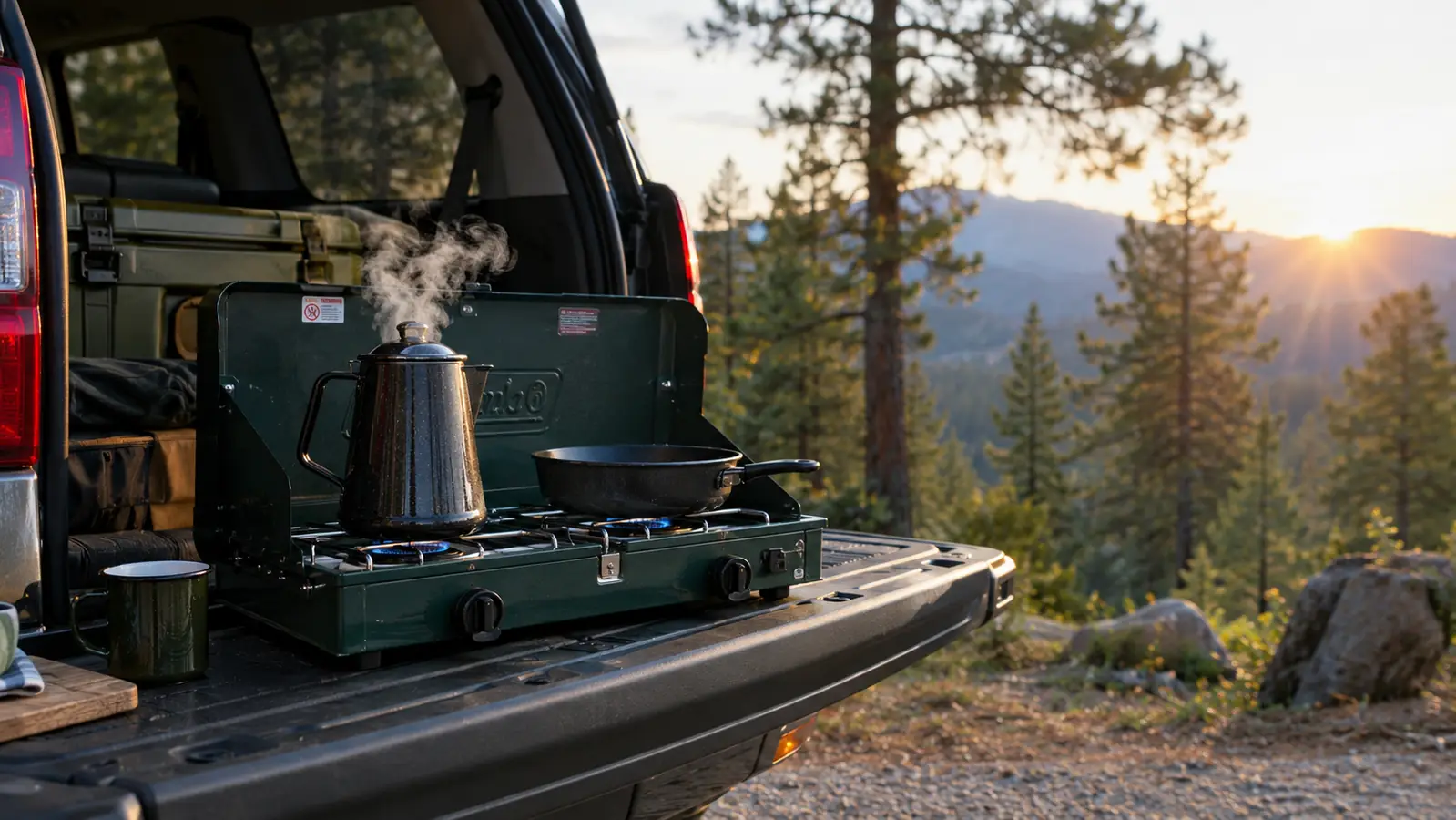
We car-camp out of a 2013 Toyota 4Runner most weekends from May through October. That means this stove rides in the back with the cooler and the tent, gets bounced around on forest roads, and has been dropped once on a gravel pad at a site near the Deschutes. It still lights on the first or second click of the igniter. The legs are still square. The regulator still threads on clean. Nothing about it has loosened up in a way that makes me nervous, and I am the kind of person who notices those things.
Most of our cooking is two people, two burners. Coffee on the left, eggs and sausage on the right. The stove handles that all morning without complaint. I have also run it as the sole cook surface for a group of six on a long weekend, which meant both burners on for long stretches. That is where the propane appetite shows up, and I will get to that honestly in a minute, because it is the one thing nobody tells you before you buy.
The clearest memory I have of this stove is a wet morning in the Three Sisters Wilderness, the kind where you wake up to fog and a cold that settles into everything. Dana stayed in the tent and I got the coffee going. The stove lit on the first click, the water boiled in the time it took me to find the mugs, and by the time I handed her a cup she was willing to believe the day would improve. That is what a good stove is, in the end. It is the difference between a trip that starts with a fight and one that starts with coffee.
What the Specs Actually Mean
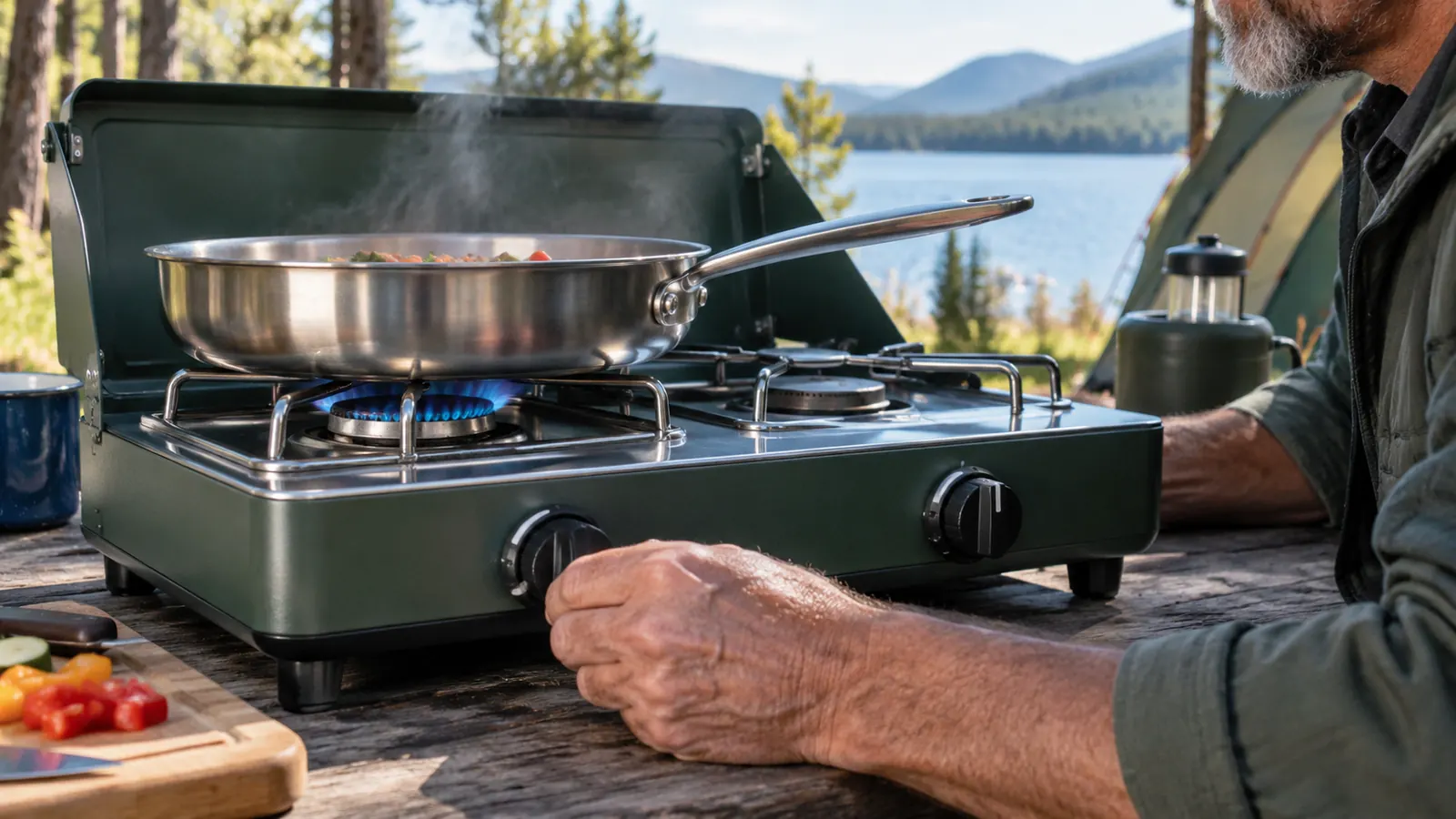
The Explorer is rated at 60,000 total BTUs across two burners, which works out to about 30,000 per burner. That number is worth understanding before you buy, because it explains both the best and the most annoying parts of this stove. On high, this thing puts out serious heat. Water that would take twenty minutes on a cheap single burner comes to a boil in under eight on this one. A cast iron skillet gets hot enough to sear, not just to warm through.
The tradeoff is that 60,000 BTUs is a lot of fuel. If you cook the way we do, breakfast for two and maybe a one-pot dinner, a standard propane cylinder lasts about a weekend. Leave both burners on high for a long stretch, like I did on the group trip, and you will be reaching for a second cylinder by Saturday night. That is the honest cost of the power. It is not a leak and it is not a defect. It is just the math of BTU output, and nobody tells you that part.
The wind guards help far more than I expected. On that windy night at elevation, the flame barely moved. On a later trip above the treeline where the gusts were worse, I turned the stove perpendicular to the wind and it still held. That is the single biggest reason I would not go back to a cheaper stove. Wind is the enemy of a small flame, and this one is built to push back rather than give in. If you have ever cooked breakfast in a gusty canyon, you know exactly how much that is worth.
The other thing the specs do not tell you is how it behaves at low heat. Plenty of stoves will boil water and then refuse to simmer. This one settles down to a low, steady flame without sputtering, which matters for a pot of oatmeal or a pan of beans that needs to sit. It is not a precise simmer like a kitchen range, but it is close enough that I stopped stirring constantly and started reading a magazine while breakfast cooked.
What Nobody Tells You
The biggest thing nobody tells you is the weight and the size. This is not a backpacking stove and it is not trying to be one. Fully assembled it is heavy, and even folded it takes up a real corner of the cargo area. If you want a stove that fits in a daypack, this is not it. This is a car-camp stove, and it is honest about that. My rule of thumb is that if you are loading it next to a cooler and a tent, you are using it right. If you are weighing it for a hike, you have the wrong tool.
The second thing is the regulator. The one that comes with it works fine, but the connection is finicky if you cross-thread it. I have done that exactly once in four seasons, and it hissed until I backed it off and rethreaded it. Not a big deal, but it is the kind of detail you only learn by owning the thing. There is no reason to replace the regulator, you just need to be patient when you thread it on. The first time, you will probably do it wrong. That is not the stove's fault, it is a learning curve.
The third thing is cleaning. The burner heads need to be wiped down and the drip pan needs attention after a messy breakfast. It is not hard, but if you are the type who throws the stove in the truck and forgets about it until next spring, the grease will be waiting for you. I have learned to give it a quick wipe while the coffee is brewing. Thirty seconds at the right moment beats an hour of scrubbing in the spring, and it keeps the burners looking and acting new.
One more honest note. The built-in igniter is a convenience, not a guarantee. In four seasons it has worked most of the time, and when it does not, a long-handled lighter finishes the job in a second. I mention this because some reviews make the igniter sound like the whole reason to buy the stove. It is not. The reason to buy it is the steady flame and the build quality. The igniter is a nice extra that occasionally needs a backup, and that is fine.
How It Compares to What I Used Before
Before this, I went through a run of cheap two-burners that cost about half as much. They worked fine for about a season and a half. Then the valves got stiff. The burners started to yellow and sputter. One of them folded in a way it never unfolded. I replaced two of them in three years, which means the cheap option ended up costing more than the Camp Chef, with worse performance the whole time. That is the math that finally made me spend the money once and stop spending it twice.
I have also borrowed a single-burner stove, the kind that screws onto the top of a propane cylinder. It is fine for a solo trip and it packs down to nothing. But cooking a real breakfast on it means juggling one pan at a time, and in any kind of wind it is a losing battle. For two people who camp most weekends, a single burner is a compromise, not a solution. I bring one along sometimes for a base camp, but the Explorer does the real work.
I looked at the fancier brands with the built-in igniters and the lighter bodies. They are genuinely nice, and they weigh less. But they cost a good deal more, and I could not find a reason to pay the difference when the Camp Chef lights on the first click, cooks the same food, and has parts that are simple to find. Sometimes the expensive option is worth it. For me, this was the place where the middle option was the right one, and I have not second-guessed that decision once.
The thing that finally sold me on the Camp Chef was the idea that I would never have to hunt for parts. The legs, the valves, the burner heads, all of it is standard stuff that you can find without a special order. When something does wear out, and something always does eventually, I will not be replacing the whole stove because of one small broken piece. That is the kind of thinking that saves money over a decade, even if it does not show up in the first month.
What I Liked
- Holds a steady flame in wind that would blow out a smaller stove
- Lights on the first or second click of the igniter, four seasons in
- 60,000 total BTUs means real heat, fast boil, proper sear
- Folds flat and survives the back of a truck
- Simple construction, standard parts, nothing proprietary to hunt down
Where It Falls Short
- Heavy and bulky, it is a car-camp stove, not a backpacking one
- Runs through a propane cylinder in about a weekend of normal use
- Regulator connection is finicky if you cross-thread it
- Needs regular cleaning or the burners and drip pan will collect grease
The wind came up to twenty-five miles an hour that night at 6,800 feet, and the flame on the Camp Chef barely flickered. That is the moment I stopped shopping for stoves.
Who This Is For
This is for the person who camps out of the back of a vehicle most weekends, cooks real meals, and wants to buy one stove and be done with it. If you are in your fifties like me and you are tired of replacing gear every couple of seasons, this is the stove that ends the cycle. It is also for anyone who has ever watched a small flame die in the wind and decided they were done with that particular fight. If you recognize yourself in any of that, the Explorer is worth your money, and you will not be sending it back.
Who Should Skip It
If you backpack, this is not your stove. It is too heavy and too big, and there are proper options for that use. If you camp once a year and only boil water, you can get away with something cheaper, though you will likely replace it sooner than you think. And if the fuel cost is a real concern, the BTU output means you will go through cylinders faster than you would on a low-power stove. That is the honest tradeoff, and I would rather you know it before you buy than discover it at the first breakfast.
Look, I am not a gear reviewer and I do not pretend to be one. I am a retired power-line foreman who camps most weekends and wants the stove to work so he can drink his coffee and watch the sun come up over the desert. Four seasons in, the Camp Chef Explorer does exactly that. If you are in the market for a two-burner stove and you plan to keep it for a decade, this is the one I would buy again tomorrow.
The stove I keep coming back to, four seasons in
The Camp Chef Explorer is the last two-burner stove I plan to buy. If you car-camp and cook real meals, check today's price on Amazon before you buy another cheap one.
Amazon Check Today's Price on Amazon →