
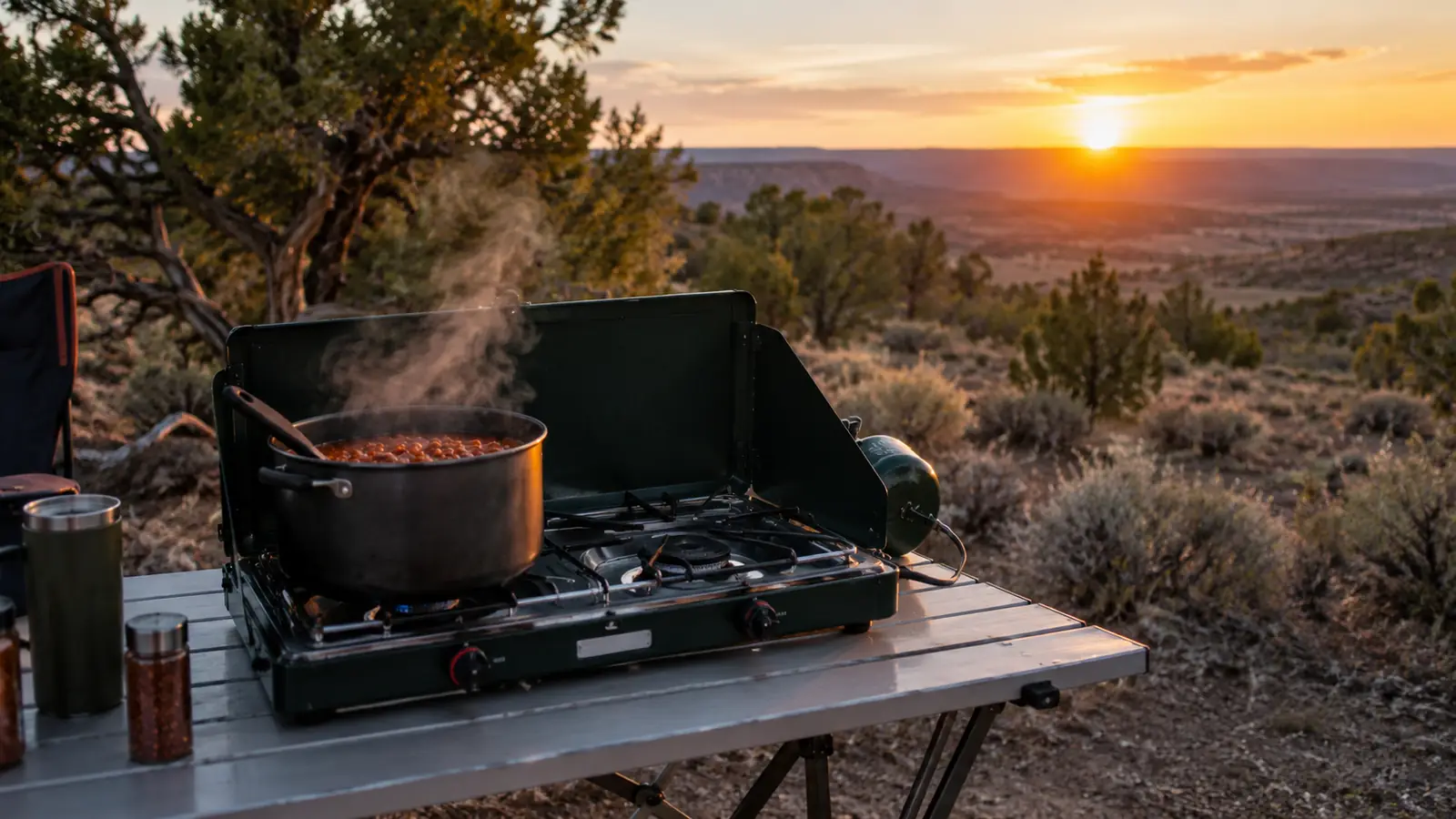
The first meal I cooked on this stove was a test, not a celebration. It was late May, snow still banked on the north side of the pass, and Dana and I had driven the 4Runner up a Forest Service road outside Sisters. I had bought the Camp Chef Explorer the week before, unboxed it in the driveway, and lit it once to check the regulator. Now it sat on the tailgate, both burners hissing, a cast iron skillet warming with three strips of bacon in it. If it could cook breakfast at 28 degrees with a wind coming off the snowfield, it could cook anything.
Three seasons later, that same stove has cooked somewhere around eighty meals. Breakfast tacos at Smith Rock. Chili on a cold October night near the Deschutes. A full turkey breast in a foil pan, which surprised me more than anything else it has done. This review is about what the Camp Chef Explorer does over years of real use, not what it does on the first weekend. Any stove can impress you once. The question is whether it still lights, still holds a steady flame, and still cooks evenly when you pull it out of the back of the truck for the thirtieth time.
The Quick Verdict
After three seasons and roughly eighty camp meals, the Explorer is the stove I reach for without thinking. It is not the lightest or the cheapest, and wind can be a problem on exposed sites. But it cooks real food at real temperatures, the regulator has never hiccuped, and nothing has broken. That is exactly what I want out of a piece of camp gear that is supposed to last a decade.
Amazon Check Today's Price →The stove I cook every real camp meal on
Three seasons in, the Camp Chef Explorer still lights on the first click and holds a steady flame. If you cook actual meals at camp instead of reheating foil packs, this is the two-burner I would buy again tomorrow.
Amazon Check Today's Price on Amazon →How I've Used It
Between May and October, Dana and I get out most weekends. That is the honest rhythm of it. We car-camp out of the 4Runner, usually in the Cascades or the high desert east of them. Some trips are two nights, some are four. The stove rides in a plastic tub in the back, wedged between the cooler and the duffel bag, and it has taken a lot of gravel road bouncing without a single complaint.
In practical terms, I have lit this stove somewhere around two hundred times. I have cooked breakfast in snow flurries at 7,000 feet. I have simmered a pot of beans for two hours on a low flame while we played cards at a picnic table. I have run it at full output to boil water for pour-over coffee before sunrise, and I have let it idle on the lowest setting to keep a sauce warm. It has done all of it without me giving the stove a second thought, which is the highest praise I can give a piece of camp equipment.
The one thing I have never done is backpack with it. At over 30 pounds, this is a car-camp stove, full stop. I knew that when I bought it. If you are looking for something to strap to a pack, stop reading now and look at a single-burner ultralight stove instead. This review is for people who drive to camp, cook real food, and want one Camp Chef that will outlast the truck.
What the 60,000 BTUs Actually Mean
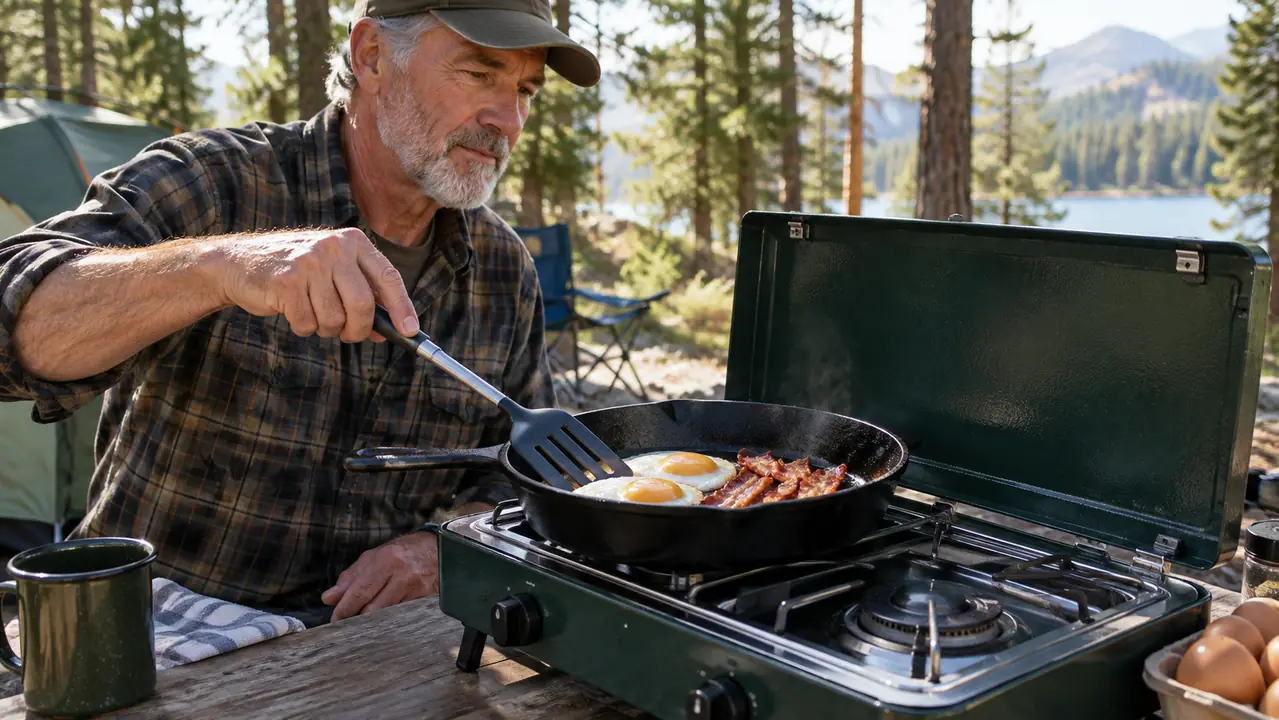
The headline number on the box is 60,000 total BTUs, which works out to 30,000 per burner. Numbers like that are easy to roll past, so let me tell you what it actually feels like. On a cold morning, a two-quart pot of water for coffee comes to a rolling boil in about four minutes with both burners on. That is not restaurant speed, but it is fast enough that you are not standing around stamping your feet. On the same trip, I can run a cast iron skillet on the left burner and a percolator on the right, and neither one starves the other. That is the real value of the BTU number. It is not about boiling faster. It is about cooking a full breakfast at the same time without either burner fading.
The controls are simple gas knobs with a wide range. I was worried when I first saw them that the low setting would be too touchy, the way some two-burner stoves go from nothing to roaring with a quarter turn. That has not been the case here. The flame settles into a low, even simmer that has held a pot of chili for an hour without scorching the bottom. On the high end, the flame is strong and blue, and it has not yellowed or sputtered even on the coldest mornings.
The fold-down lid does double duty as a wind screen. It is not a great wind screen, and I will get to that in a minute, but it is better than nothing. On a calm site it cuts most of the breeze. On an exposed ridgetop it will not save you. The lesson I learned the hard way is to park the truck between the stove and the wind, or find a natural bowl in the ground. That is not a stove flaw. It is just how propane flames behave.
Cooking Real Meals, Not Just Heating Things Up
The reason I bought a two-burner stove instead of a single was not convenience. It was because I wanted to cook actual meals, the kind I would cook at home, and a single burner forces you to eat in sequence: boil the pasta, drain it, then start the sauce, and by the time the sauce is done the pasta is cold. The Explorer lets me run a protein on one side and a side on the other, and that changes the whole character of a camp meal.
My standard trip meal is chicken thighs in the cast iron on the left burner, and a foil packet of potatoes and onions on the right, with a lid I keep in the truck to help the second side cook through. That meal takes about twenty minutes of active attention and tastes like something I would serve at my own dinner table. On the same principle, I have done burgers, eggs, pancakes, a whole trout in a pan, and a slow-braised pot roast on a three-day trip where we had time to let it go.
The moment that sold me permanently was the turkey breast. On an October trip near the Deschutes, Dana and I decided we wanted a proper early Thanksgiving meal at camp. I put a five-pound turkey breast in a foil pan with butter and herbs, covered it, and ran it on a low flame for about two hours, turning the pan a few times. It came out cooked through, juicy, and brown on top. You cannot do that on a single burner, because you cannot babysit a low flame for two hours while you also cook the sides. Two burners and a steady low setting made it possible.
Wind, Fuel, and the Things That Annoy Me
Now the honest part, because no stove is perfect and this one has real flaws. The first is wind. The fold-down lid helps on a calm day, but on an exposed site a gust will flatten the flame on the side facing the breeze. I have had to move the whole setup, stove and table, to the lee of the truck more than once. On one trip near Smith Rock the wind was steady enough that I gave up and cooked on the ground behind a rock wall. The stove worked fine there. It just needs a little help, and that help is not built in.
The second annoyance is the regulator and hose. They work, and they have worked for three seasons without a single hiccup, but the hose is stiff when it is cold and the regulator is not the most compact thing to pack. I store it in the plastic tub with a coil of paracord and it is fine. If you are the type who wants everything to nest perfectly inside itself, this stove will not do that for you. It packs into a fairly large, boxy footprint.
The third thing is cleanup. The grates are cast iron, which is wonderful for cooking and slightly annoying to clean. Food sticks if you do not oil the pan, and the drip tray underneath catches the mess but then has to be scraped out. I have learned to line it with a piece of foil before a trip, which makes the whole job a two-minute rinse instead of a scrubbing session. None of this is a reason not to buy it. It is just the reality of cooking real food outside instead of boiling water in a jet boil.
Three Seasons of Hard Use: What Broke and What Did Not
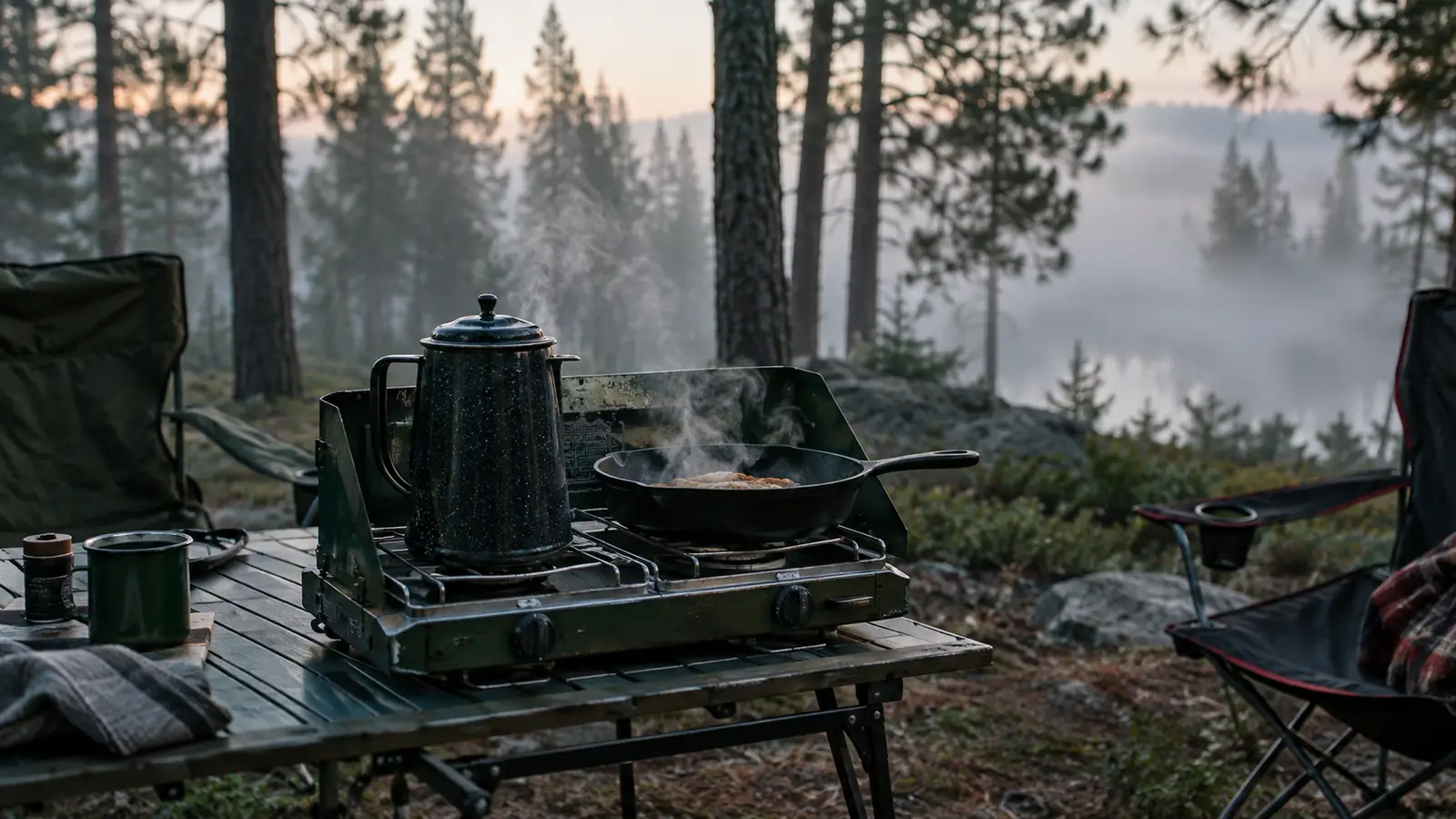
Let me give you the durability report, because that is the question everyone actually asks. After three seasons, roughly eighty meals, and a lot of gravel road in the back of the 4Runner, nothing on this Camp Chef has broken. The regulator still clicks on the first press. Both burners light immediately and burn evenly, left and right, high and low. The fold-down lid still latches cleanly. The legs still snap into place without binding. I have replaced the disposable propane cylinders maybe a dozen times, and every single one has threaded on and off without cross-threading, which is more than I can say for a cheaper single-burner I owned before this one.
The only wear I can find is cosmetic. The paint on the lid has a few chips from years of being tossed into the tub and bounced against the cooler. The drip tray has a light layer of baked-on oil that I have never fully scrubbed off. The cast iron grates have the dark, seasoned look that cast iron always gets. None of it affects performance at all.
I also want to be clear about the fuel. This stove runs on standard disposable propane cylinders, the green ones you can buy at any gas station. I have never used an adapter for a bulk tank, so I cannot speak to that. What I can say is that a single cylinder lasts me roughly four to five meals of real cooking, which is more than a weekend trip and often two. That is the one operating cost I pay, and it is small enough that I stopped tracking it.
Ignition and Daily Details
The ignition has been flawless, which is not something I can say about every propane appliance I have owned. It is a simple push-button piezo spark, one press per burner, and it has lit on the first press every single time, even after the stove sat in the tub for six weeks over the winter. I have never carried a lighter or matches for this stove, and I have never needed them.
The legs and the table setup are worth a note. The legs fold out and lock with a positive click, and the stove stands steady on uneven ground, which is most ground at a campsite. The two side tables that fold down give me a place for a cutting board and a stack of plates, which sounds minor until you have cooked a full meal with nowhere to set a spatula. They are not load-bearing, so do not sit on them, but for food prep they are genuinely useful.
What I Liked
- Cooks real meals at real temperatures, two burners that do not starve each other
- Wide flame range, from a low simmer to a strong boil, and it holds both
- Nothing has broken or worn out in three seasons of heavy car-camp use
- Runs on standard disposable propane cylinders found at any gas station
- Cast iron grates and a drip tray that catches most of the mess
- Simple push-button ignition that has never failed in three seasons
Where It Falls Short
- Heavy and boxy at over 30 pounds, clearly a car-camp stove only
- Wind performance needs help; the fold-down lid only does so much
- Cast iron grates need oiling and a little care to clean
- Packs into a large footprint and does not nest compactly
- Regulator hose is stiff in cold weather
Three seasons and roughly eighty meals in, nothing on this stove has broken. The regulator still clicks on the first press and both burners light immediately.
Who This Is For
This stove is for the person who drives to camp, sets up a real kitchen, and cooks real food. It is for the couple who wants breakfast tacos and proper chili and the occasional roasted turkey breast, not freeze-dried packets. It is for the weekend camper in the Cascades or the high desert who is tired of fighting a single burner and wants one stove that just works for a decade. If that is you, and you have a vehicle that can carry 30 pounds without a second thought, this is the two-burner I would put in the back of the truck.
Who Should Skip It
If you backpack, this is not your stove. At over 30 pounds it will never go on your back, and you should buy a single-burner ultralight stove and save the weight. If you only make coffee and boil water for dehydrated meals, a single burner will do that job with half the weight and a quarter of the footprint. And if you camp in exposed, windy places every single trip, you should know that this stove needs you to find shelter from the wind, not the other way around. None of that makes it a bad stove. It just means it is not the right tool for every job, and pretending otherwise would be dishonest.
The stove that has cooked eighty meals without a single breakdown
Three seasons in, the Camp Chef Explorer is still the first thing I load into the 4Runner. If you cook real food at camp and want one stove to last a decade, this is the one.
Amazon Check Today's Price on Amazon →