
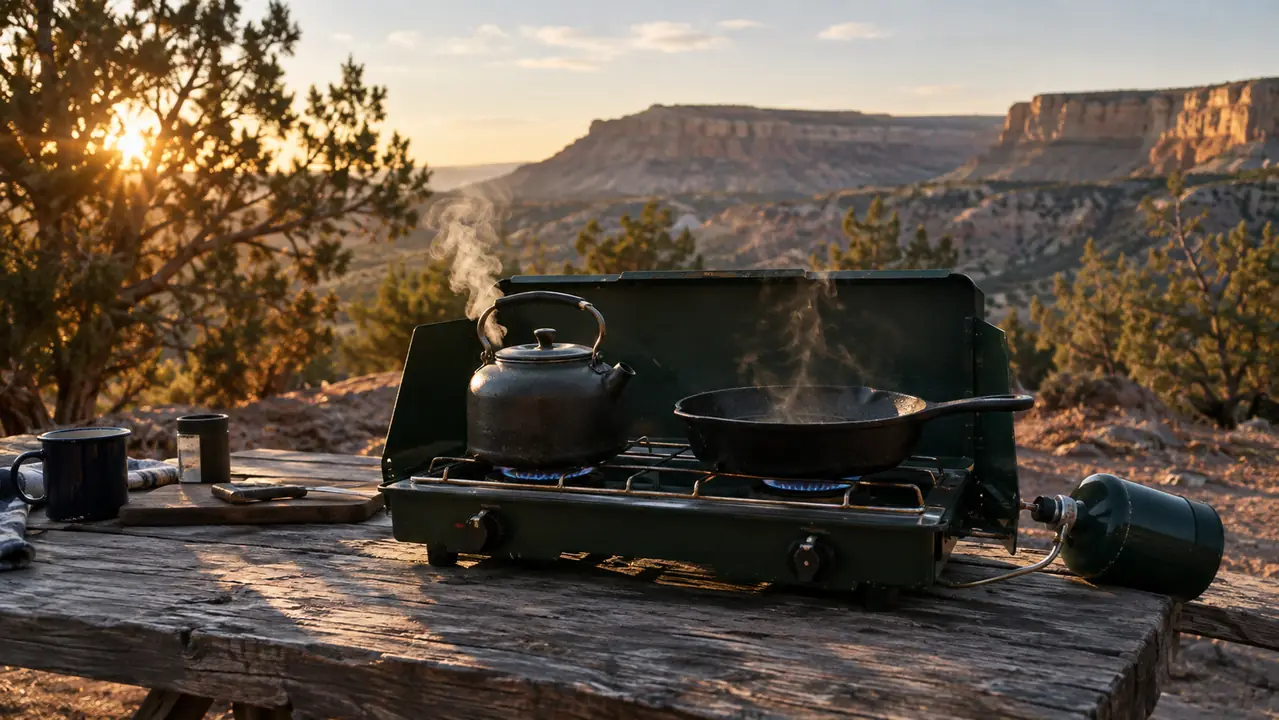
For about four years I cooked every camp meal on a small single-burner backpacking stove, including meals for two people at a car campsite ten steps from the tailgate of my 4Runner. It worked, in the sense that food eventually got hot. Then I borrowed a Camp Chef Explorer two-burner from a neighbor for a long weekend at Smith Rock and spent the entire drive home wondering why I had spent four years boiling water one pot at a time. This is the comparison I wish someone had laid out for me before I made that choice, because the two stoves are not competing for the same job even though they sit next to each other on the same shelf.
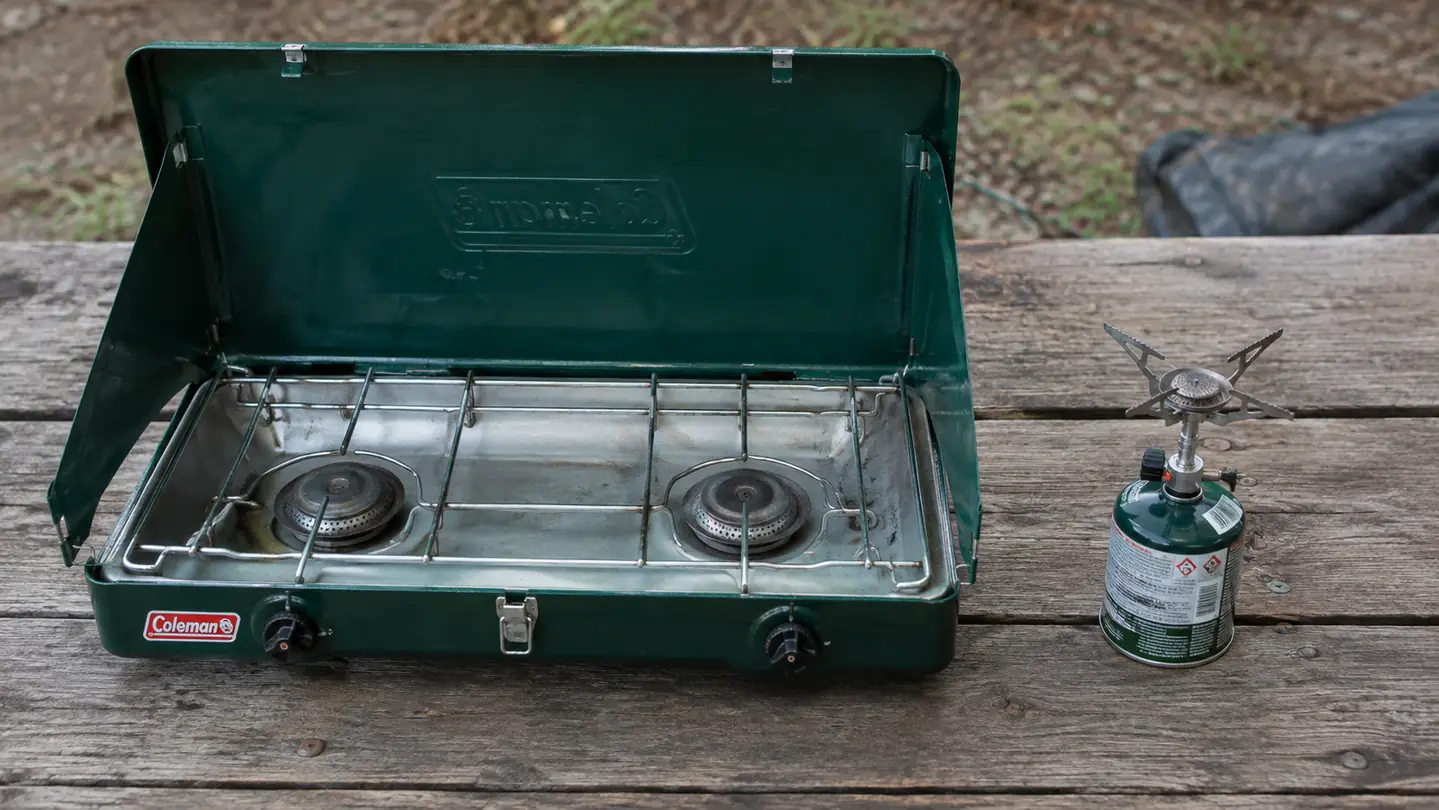
A single-burner backpacking stove is a small screw-on burner that runs off an upright canister, weighs almost nothing, and is built to boil water fast in a place you had to walk to. The Camp Chef Explorer is a freestanding two-burner propane stove on legs with a windscreen, closer to a kitchen range than to a backpacking tool. Both cook food. Almost nothing else about them is the same.
| Camp Chef Explorer Two-Burner | Single-Burner Backpacking Stove | |
|---|---|---|
| Cooking two things at once | Two independent burners, coffee and eggs together | One pot at a time, everything goes cold waiting |
| Weight and bulk | Heavy. This is a vehicle stove and nothing else | Fits in a jacket pocket with the canister |
| Performance in wind | Three-sided windscreen and legs keep the flame steady | A steady breeze doubles your boil time |
| Real heat output | Enough to run a full pan and actually sear | Fine for boiling, poor at anything needing control |
| Simmer control | Turns down low enough to hold a sauce | Tends to run wide open or barely lit |
| Setup time | Unfold the legs, connect the hose, about a minute | Screw on the canister, a few seconds |
| Fuel cost per meal | Bulk propane, cheap over a season | Small canisters, expensive per meal |
| Best use | Car camping and base camps cooking real food | Backpacking, and boiling water for two |
The second burner is the whole argument
Everything else in this comparison is detail. The reason the Camp Chef changed how we eat in camp is that two things can be hot at the same time. On a single burner, a camp breakfast is a sequence. You boil the coffee water, then you pour it off and the pot goes back on for eggs, and by the time the eggs are done the coffee has gone lukewarm in the cups. You eat in shifts. I did this for years and genuinely did not notice it was a problem until it stopped being one.
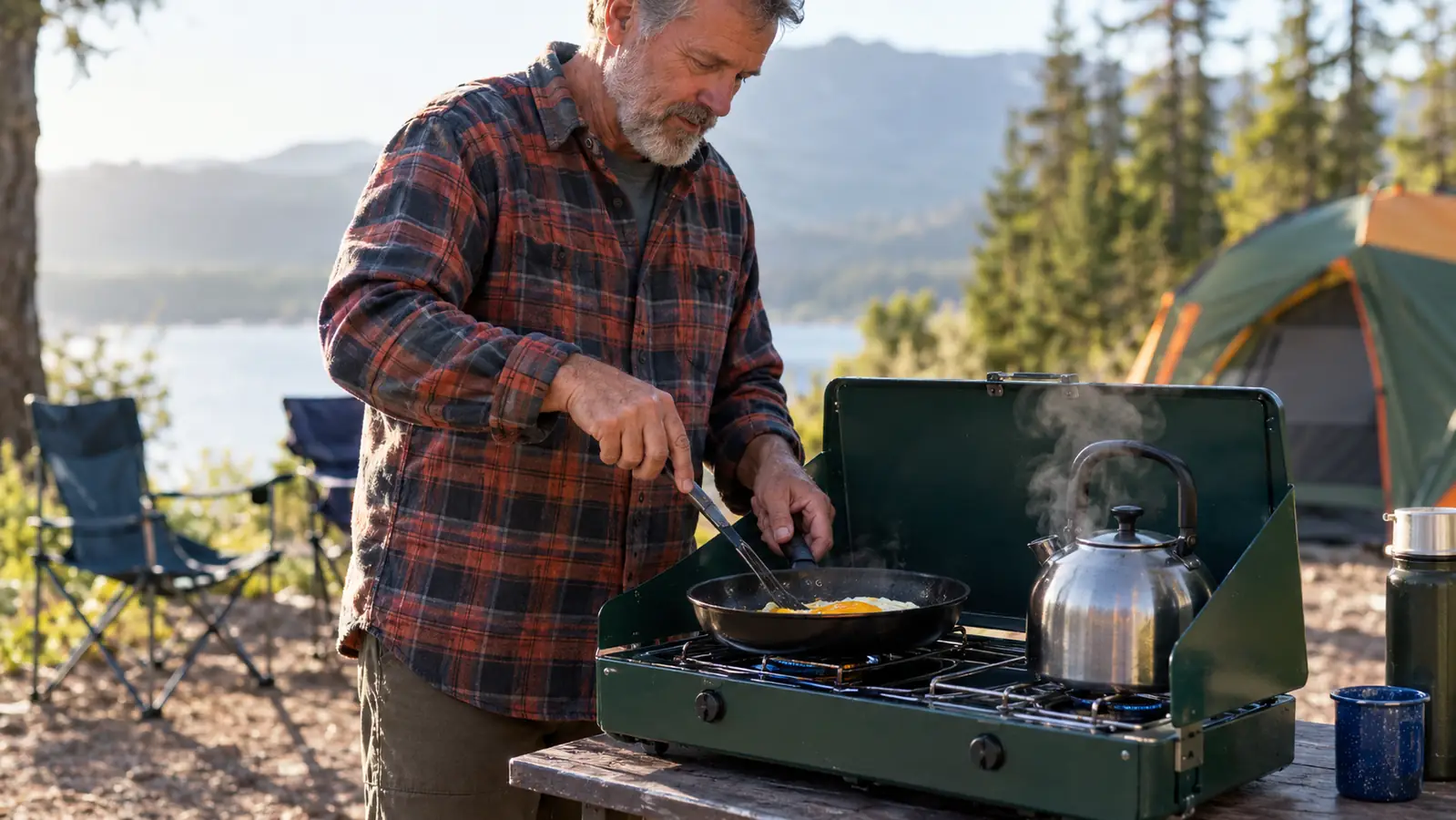
With two burners, the kettle sits on the right at a low flame while a pan works on the left, and breakfast arrives all at once and hot. Dana pointed out on that first trip that we sat down and ate together for the first time in years of camping, which had never occurred to me as something the stove was responsible for.
On a single burner, camp breakfast is a sequence and somebody always eats cold. Two burners is the difference between cooking and reheating.
Wind is the failure nobody plans for
The high desert east of the Cascades gets a steady afternoon wind almost every day in summer, and wind is what exposes a small canister stove. The burner sits exposed on top of the canister with the flame completely open to the air. A moderate breeze does not blow it out, it just strips the heat sideways off the bottom of your pot. Boil times stretch out, fuel drains, and you find yourself crouching over the thing with your back to the wind holding a jacket open like a windbreak. I have done exactly that more times than I want to admit.
The Camp Chef sits on legs with a three-sided windscreen around the burners, which is a plain mechanical solution to a plain mechanical problem. In the same afternoon wind that turns a canister stove into a hand-warmer, the Explorer just cooks. That was the single biggest surprise of the switch, more than the second burner, because I had accepted the wind problem as a fact of camping rather than a fact of that particular stove.
Where the single-burner stove wins outright
I still own my single burner and I still carry it, and I would not let this comparison suggest otherwise. If you are walking any meaningful distance, this is not a contest. The Camp Chef is heavy, it takes up real space, and it is designed around the assumption that a vehicle is carrying it. Nobody is putting one in a pack.
The small stove also wins on speed of setup for a quick stop. Screwing a burner onto a canister to make coffee at a trailhead is a few seconds of work. Unfolding legs and connecting a hose for one cup of coffee is not worth the trouble, and on day hikes the small stove is still what rides in my daypack. They are complementary tools, and I would rather own both than own the wrong one.
The stove that made us stop eating in shifts
Two real burners, a windscreen that works in high desert afternoons, and enough control to cook rather than just boil. The Camp Chef Explorer is the one that lives in the truck now. Check today's price on Amazon.
Amazon Check Today's Price on Amazon →Simmer control is the difference between cooking and boiling
Small canister stoves are optimized to bring water to a boil quickly, and they are genuinely good at it. What most of them do poorly is run low and steady. The valve tends to have a narrow useful range, so you get a roaring flame or something close to out, with very little in between. That is fine for freeze-dried food, where boiling water is the entire technique.
If you want to cook actual food in camp, you need a flame you can hold low without losing it. The Camp Chef will hold a sauce at a bare simmer on one side while the other side runs hot for a pan. That opens up chili, a real sauce, anything with onions that need to soften rather than scorch. The first thing I noticed was that I stopped burning the bottom of everything, which I had assumed for years was my fault rather than the stove's.
Fuel is cheaper over a season than I expected
This one is easy to overlook when comparing them in a store. The small stove runs on sealed canisters that are convenient and costly per meal, and on a long weekend cooking twice a day for two people you go through them faster than you think. You also end up with partly used canisters that are awkward to store and awkward to dispose of, and I have a shelf of them to prove it.
The Camp Chef runs off bulk propane, the same kind of tank that feeds a backyard grill, using an adapter hose. Over a full season of weekends the fuel cost stops being something I think about, and there is no pile of half-empty canisters at the end of the year. If you camp often, the fuel side alone tilts the arithmetic well before the stove pays for itself.
What I would tell somebody standing in the aisle
Ask one question and the answer falls out immediately. Are you carrying this on your back, or is it riding in a vehicle? If it goes on your back, buy the single burner and do not think about it again. Weight decides it and nothing else comes close.
If it rides in a vehicle, buy the Camp Chef Explorer. The small stove will technically do the job and you will keep quietly working around its limits, cooking in shifts, shielding it from the wind, scorching the bottom of the pan, the way I did for four years without ever framing it as a problem worth solving. The two-burner is not a more advanced version of the small stove. It is a different tool for a job the small one was never built to do.
If your camping is genuinely split between both, own both. Mine live in different bins and I have never once been confused about which one to grab, because the decision is made in the driveway by whether the gear is going in the truck or on my shoulders.
Cleaning up, which is half of camp cooking
Nobody puts cleanup in a stove comparison and it is honestly half of the experience. A small canister stove has almost nothing to clean, which is a real advantage. You wipe the burner head, unscrew the canister and it goes back in the bag. The trade is that whatever you spill lands on whatever the stove is sitting on, usually a picnic table or a rock, and that mess is now your problem.
The Camp Chef has a removable drip tray under the burners, which sounds like a small thing until the first time a pan boils over. Grease and spilled coffee land in the tray instead of running across the table and down into the seams where you put your plate. I pull the tray out, wipe it, and slide it back. It takes a minute and it is the difference between a cooking surface I am willing to set food on and one I am not.
Two years in, what has actually worn out
Durability is hard to judge in a store and easy to judge after a couple of seasons. The single burner has been reliable in the sense that there is very little on it to fail. The piezo igniter on mine quit working in the second year, which is by far the most common failure on that style of stove, so I carry a lighter and think nothing of it. Everything else on it still works.
On the Camp Chef, the burners and the valves have held up with no change in behavior, and the legs still lock where they are supposed to. What shows wear is the finish. The top has scorch marks and the windscreen has discolored around the burners from heat, both cosmetic. The one piece I would call a genuine wear item is the regulator hose, which is rubber and lives in a bin with heavier things on top of it. I check it at the start of each season by running a little soapy water along it with the propane on and looking for bubbles, which takes two minutes and is worth doing on any propane appliance.
A note on cooking for more than two people
Everything above assumes two people, because that is how Dana and I camp. If you regularly cook for four or more, the comparison stops being close enough to argue about. Feeding four people one pot at a time is not really cooking, it is portioning, and the first two servings are cold before the last one exists.
The Explorer's burners are spaced far enough apart to run two full-size pans at once, which is the thing that small two-burner stoves get wrong. I have used compact two-burners where the burners sit so close together that a normal pan on one side overhangs the other, and you end up back to cooking one thing at a time with extra steps. Check the spacing on any two-burner you are considering, not just the burner count.
The mistake I made for four years
I want to name the actual error plainly, because I suspect it is common. I owned a stove that worked, so I never asked whether it was the right stove. Every workaround I had built up, cooking in sequence, crouching against the wind, accepting scorched pans, had become invisible to me as a set of problems. They were just what camp cooking was.
Borrowing a neighbor's stove for one weekend is what broke that, and it is why I would tell anybody on the fence to cook one meal on a two-burner before deciding. Not read about it, cook on it. The difference is not in the specifications, it is in what a Saturday morning in camp feels like when the food and the coffee arrive at the same time and neither of you is standing up holding a jacket open against the wind.
If your stove rides in the vehicle, stop cooking one pot at a time
A windscreen that handles a real breeze, a burner that holds a low simmer, and bulk propane instead of a shelf of half-used canisters. See today's price on Amazon.
Amazon See Today's Price on Amazon →