

I have slept on the ground in one form or another for thirty years, and I can tell you the exact night I gave it up. It was a June trip into the Three Sisters Wilderness, the ground still holding snowmelt, and my Therm-a-Rest went soft around midnight. By 3 a.m. my hip was numb and my back was telling me things I did not want to hear. I broke camp in the dark, drove home, pulled the Coleman Trailhead II cot out of the garage, and hauled it right back up the mountain. That was the last night I spent trying to make the dirt behave like a bed.
So which one actually gets you off the ground? The honest answer is that they solve different problems. A cot lifts you up and gives you a real bed shape. A sleeping pad insulates you from the cold earth. If you car-camp, sleep warm, and hate climbing up off the floor at 2 a.m., the Coleman cot is the better tool. If you backpack, sleep cold, or pitch a small tent, an insulated pad wins. I own both and use both. The table below is the whole argument in one glance, and the longer version follows, including the night the cot taught me its one real weakness.
| Coleman Trailhead II Cot | Therm-a-Rest NeoAir XLite Pad | |
|---|---|---|
| Price | Costs a fraction of a premium pad, even on a sale year | Costs several times as much for the same warmth |
| Insulation | None. Cold air moves freely underneath the fabric | Real R-value stops ground cold on 30-degree nights |
| Height | Sits high enough to use as a chair, easy to get out of | Ground level. You roll off the floor in the morning |
| Packed size | Long folding bundle that rides on the roof or back seat | Rolls to roughly the size of a rolled sleeping bag |
| Durability | Steel frame and heavy fabric, nothing to puncture | One thorn or dog claw can end your night |
| Setup | Unfold, lock the legs, done in under a minute | Needs a pump sack or a few minutes of lung work |
| Weight | Around twenty pounds, fine for the back of a 4Runner | A bit over a pound, made for a backpack |
| Best for | Basecamp, car camping, guests, afternoon lounging | Backpacking, winter nights, small tents |
Where Coleman Wins
Start with the obvious one: price. The Trailhead II does not cost much, and it does the job of sleeping pads that cost several times more. I have had mine for six years, and it has been slept on by me, by Dana, and by guests who topped 250 pounds. The frame has not bent, the fabric has not torn, and the legs still lock tight. Nothing about it inflates, leaks, or needs patching, which is more than I can say for any inflatable pad I have owned in that same stretch.
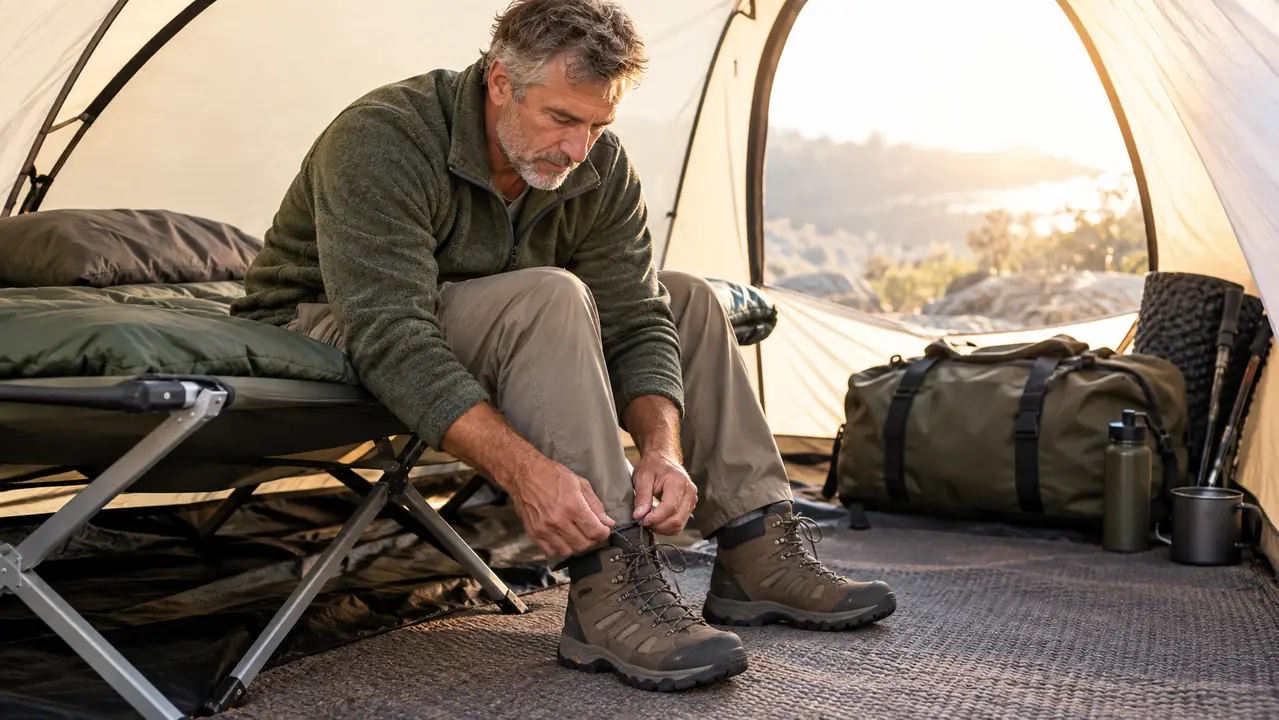
The other big win is the height. The cot sits high enough that I can sit on the edge and lace my boots without folding myself in half. At 54, with a back that has done thirty years of hard work, that matters more than it used to. You are also off the damp ground when the weather turns, off the gravel, and off the pine cones that always find their way under a tent floor. And when the tent is not in play at all, the cot works as a camp chair, a gear table, and a place to nap in the afternoon shade. On one trip it spent a full afternoon as a gear table in full sun while I fished the Deschutes, and it never so much as creaked.
The cot does not insulate you. Cold air moves underneath it all night long. That is the one thing nobody warns you about before you buy.
Where the NeoAir XLite Wins
Here is the honest part. A cot gets you off the ground, but it does not get you warm. The Trailhead II is a stretched piece of fabric over open air, and air moves underneath it all night. On a September night in the high desert east of Bend, when the temperature drops into the low thirties, that moving air steals heat from below. My first cold night on the cot taught me this in a hurry. The pad, by contrast, is built to do exactly one job: stop the ground from pulling heat out of your body. On that same 30-degree night, the NeoAir keeps my hip from ever feeling the cold. That single weakness is the reason the pad still has a permanent spot in my truck.
The pad also wins every argument about weight and space. The NeoAir rolls down to about the size of a rolled-up sleeping bag and weighs a bit over a pound. The cot folds into a long, awkward bundle that takes over the back seat or rides strapped to the roof of the 4Runner. When I section-hiked the PCT in my forties, the cot was never an option and the pad was the entire point. Even for car camping, the pad earns its place on trips where the tent is small, or where I want the truck bed free for firewood and coolers. For that reason alone, the pad is the one that goes with me on any trip that starts with a trailhead sign.
If you camp from a vehicle, this is the cot I would buy again
Six years in, the Trailhead II is still the first thing I load. It costs a fraction of a premium pad, has never failed me, and doubles as a camp chair. Check today's price on Amazon.
Amazon Check Today's Price on Amazon →The Cold-Night Problem Nobody Warns You About
I want to be plain about the cot's weakness, because an honest review has to have one. The Trailhead II has no insulation of its own. On a warm July night, that is a feature, because the air moving under you keeps you from baking. Below about 45 degrees, it becomes a problem. The cold air under the cot does not just feel drafty. It pulls heat out of your back all night long, and no amount of blanket on top fixes it from above. The fix is simple: put something between you and the fabric. It is the difference between a good night and a long one.
My solution is a cheap closed-cell foam pad laid on top of the cot. It adds almost no weight, costs very little, and turns a cold cot into a warm one. I keep one rolled behind the seat of the 4Runner from September on. Some campers use a self-inflating pad on the cot instead, and that works too, but then you are carrying two sleeping systems and the point of the cot starts to fade. For me, the foam pad is the answer, and it is the reason the cot stays in the truck all season instead of going back to the garage.
What I Learned Sleeping on Both for a Season
To write this fairly, I spent a full season rotating between the two. May through October, I alternated weekends: one trip on the cot, the next on the pad, same tent, same sleeping bag, same stretch of the Cascades and the high desert. What I learned is that they are not rivals. They are tools for different nights, and the sooner you stop trying to make one do both jobs, the better your sleep gets. I kept a notebook in the truck and wrote down how each one slept, because memory lies about nights in the mountains.
The cot won every warm night and every night I wanted to sit up and read before turning in. The pad won every night below 45, every night in the small two-person tent Dana and I use when we are moving camp each day, and every trip where the hike in was longer than a hundred yards from the truck. The difference showed up most on the second night of a trip, when a bad first night catches up with you. If I had to keep only one, it would be the cot, because I car-camp more than I backpack and my back is 54 years old. But I would not want to give up the pad on a cold night, and I do not plan to.

What Broke and What I Replaced
In six years, exactly two things have needed attention. The first was a leg lock that started to stick after a guest rocked hard getting out. A shot of silicone spray fixed it in a minute and it has not come back. The second was the carry bag, which wore through at the seam after five years of being tossed in and out of the truck. I replaced it with a cheap duffel and moved on. The fabric on the cot itself is still sound, the frame is still straight, and the legs still lock. I cannot say the same for any pad I have owned; every one of them eventually sprung a slow leak. Nothing about the cot has surprised me in a bad way, which is the highest compliment I can pay any piece of camping gear.
The pad's failures are different. Mine have all leaked eventually, usually at a seam, and a slow leak is the worst kind because it does not announce itself. You wake up at 4 a.m. on the ground with no idea when it happened. The fix is glue and a patch kit, and it holds, but it is never quite the same. I have patched three pads and retired two. The cot has needed no patches in six years, which is the strongest thing I can say about it. It is a small thing, but at 4 a.m. on cold ground it feels enormous.
The Bottom Line
After a season of rotating between the two, here is my answer in one sentence. If your trips look like mine, May to October out of the back of a 4Runner, the Coleman cot is the purchase you will not regret. If your trips involve a backpack or a 30-degree forecast, buy the pad first and let the cot wait. And if you can manage the space for both, you will never spend another night deciding which one to leave home.
Who Should Buy Which
Buy the Coleman cot if you camp out of a vehicle most of the time, if you are tired of crawling up off the ground, if you want a guest bed and a camp chair in one piece of gear, or if your nights are usually above 45 degrees. It is the better buy for the weekend car camper, for the person who resents buying the same thing twice, and for anyone who wants gear that survives a decade of weekends like mine. The Trailhead II has been in my rotation for six years and shows no sign of slowing down.
Buy the sleeping pad if you backpack, if you sleep cold, if your tent is small, or if you camp into the shoulder seasons where 30-degree nights are normal. And if you are truly unsure, the cheap path is a pad first, then add the cot once you know your nights are mostly warm ones. Most people I talk to end up with both in the garage, which is fine. But if you only have room for one, match it to the coldest night you plan to sleep through, not the warmest. And if you are buying for a guest, the cot is the kinder choice, because nobody sleeps well on a pad the first time.
The cot that outlasted every pad I have owned
Six years, countless weekends, and it still locks up tight. If you car-camp, this is the one to buy. See today's price on Amazon.
Amazon See Today's Price on Amazon →